Your face moisturizer sits on your skin for hours every day. It’s one of the last things you apply at night and often the first in the morning. That makes it a quiet but steady source of whatever ingredients are in the jar-good or not-so-good.
Many conventional moisturizers rely on synthetic preservatives, fragrance blends, and petroleum-derived fillers to stay shelf-stable, smell “luxurious,” and feel silky. The problem is that some of those ingredients can contribute to hormone disruption, skin barrier irritation, or unnecessary chemical load on a body that’s already dealing with indoor air quality, stress, and environmental exposures. Your skin is a barrier, but it isn’t impermeable. What goes on it doesn’t always stay on the surface.
Clean, effective alternatives exist that hydrate without the extras most of us don’t need.
DISCLAIMERS:
- As an Amazon affiliate, we may earn from qualifying purchases.
- The information provided here is for general informational purposes only and does not constitute medical advice. Always consult with a qualified healthcare professional for any health concerns or before making any decisions related to your health or treatment.
- Information provided in this post is updated as of the date of the post. Brands may reformulate products after the date of this post. Check back for updates.
Ingredients to Avoid in Face Moisturizers
| Ingredient | What it does | Why it’s a concern |
|---|---|---|
| Fragrance (or parfum) | Scent | An undisclosed blend of scent chemicals; fragrance is a leading cause of skin allergies from cosmetics and can include phthalates. |
| Phthalates (usually hidden in “fragrance”; DEP) | Fragrance solvent | Solvents often hidden in fragrance; one human study linked higher levels in pregnant mothers to shorter anogenital distance in baby boys. |
| Parabens (methylparaben, ethylparaben, propylparaben, butylparaben) | Preservative | Preservatives that act on estrogen receptors in lab studies; one human study linked higher levels to earlier puberty in girls. |
| Formaldehyde releasers (DMDM hydantoin, quaternium-15, imidazolidinyl urea, diazolidinyl urea, bronopol) | Preservative | Preservatives that slowly release formaldehyde, a known carcinogen; FDA also lists them among cosmetic ingredients that can cause skin allergies. |
| Ethoxylated ingredients (PEG-, polysorbate, ceteareth-, laureth-, oleth-) | Emulsifiers | May be contaminated with 1,4-dioxane, a possible carcinogen, and ethylene oxide, a known carcinogen, both by-products of how they’re made. |
| Ethanolamines (DEA, MEA, TEA, triethanolamine) | Emulsifiers, pH adjusters | Can react to form NDELA, a possible carcinogen; DEA and cocamide DEA are themselves classed as possible carcinogens. |
| Sodium benzoate (or benzoic acid) | Preservative | Can form benzene, a known carcinogen, when combined with vitamin C; shown in drinks, not well studied in skincare. |
| Synthetic dyes (Red 4, Yellow 5, Blue 1, CI numbers) | Color | Added only for color; FDA notes Yellow 5 can cause itching and hives, and hyperactivity concerns come from food studies. |
Look for instead: fragrance-free or unscented formulas, or ones that list essential oils by name (these can still irritate sensitive skin), and labels without any of the names in the table.
Popular Face Moisturizer Brands to Avoid
These are popular, widely available options that frequently contain one or more of the ingredients above. Occasional use is unlikely to cause issues for most people, but daily face application is where cumulative exposure adds up. Always check the current label-formulas change.
- Neutrogena Hydro Boost Water Gel: often contains fragrance and other synthetic additives. Lightweight feel comes with trade-offs for clean standards.
- Clinique Moisture Surge 100H: fragrance-free, but contains ethoxylated ingredients (Oleth-10, PEG-8), phenoxyethanol, and synthetic dyes (Red 4, Yellow 5). The “hydrating” marketing doesn’t always match the cleanest profiles.
- Olay Regenerist or classic moisturizers: frequently include parabens, fragrance, or PEGs in various formulas.
- CeraVe Moisturizing Cream or Facial Moisturizing Lotion: loved by dermatologists for ceramides, but many versions contain petrolatum, phenoxyethanol, PEGs, or (in some lines) parabens. Not strictly non toxic by clean-beauty criteria.
- Cetaphil Daily Facial Moisturizer or similar: can include fragrance or less-preferred preservatives in popular variants.
- First Aid Beauty Ultra Repair Cream: fragrance and other flagged ingredients appear in some formulas; effective for many but not the cleanest.
- Aveeno or similar oat-based drugstore creams: often include fragrance or synthetic stabilizers despite the “gentle” positioning.
Best Non Toxic Face Moisturizers
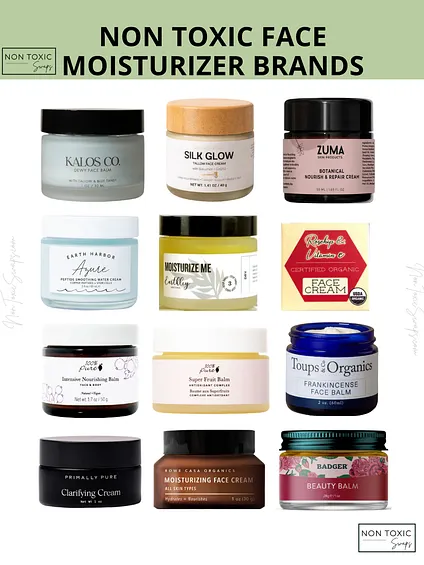
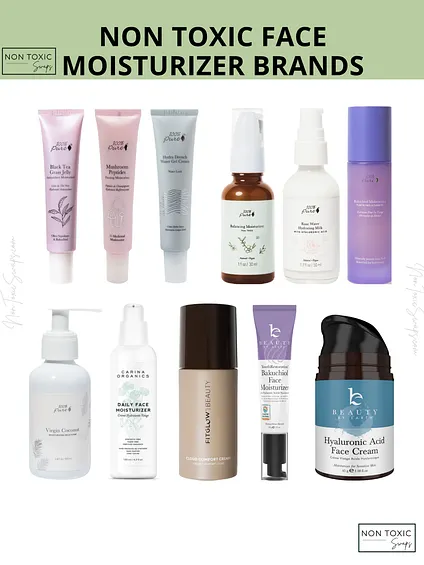
Some of these products are scented with essential oils. They’re listed by name, but they can still cause irritation or allergies, so choose unscented if your skin is sensitive.
Face Creams
- 100% Pure Green Tea EGG Concentrate Cream
- 100% Pure Hydra Drench Water Gel Cream
- 100% Pure Restorative Sea Culture Extra Riche Creme
- 100% Pure Retinol Rosehip Face Cream
- 100% Pure Superfruit Nourishing Cream
- 100% Pure Vitamin C Brightening Face Cream
- Beauty by Earth Hyaluronic Face Cream
- Bubble and Bee Face Cream
- Earth Harbor Azure Peptide Smoothing Water Cream
- Earth Harbor Siren Silk Bio-Retinol Hydration Cream
- Fitglow Beauty Cloud Comfort Cream
- Primally Pure Clarifying Cream
- Primally Pure Plumping Cream
- Primally Pure Soothing Cream
Lightweight Moisturizers, Gels and Milks
- 100% Pure Bakuchiol Facial Moisturizer
- 100% Pure Black Tea Grass Jelly Moisturizer
- 100% Pure Coffee Bean Moisturizer
- 100% Pure Green Tea ECGC Moisturizer
- 100% Pure Mushroom Peptides Firming Moisturizer
- 100% Pure Rose Water Hydrating Milk
- 100% Pure Tea Tree Balancing Moisturizer
- 100% Pure Tinted Moisturizer
- 100% Pure Virgin Coconut Moisturizing Milk Foam
- 100% Pure Vitamin C Brightening Face Cream
- 100% Pure Watermelon Cucumber Water Locking Moisturizer
- Beauty by Earth Bakuchiol Moisturizer
- Earth Harbor Mermaid Milk Nutrient Glow Moisturizer
- Earthley Moisturize Me
- Puristry Seaberry Moisturizer
Face Balms
- 100% Pure Intensive Nourishing Balm
- 100% Pure Super Fruit Balm
- Badger Beauty Balm
- Earth Harbor Nymph Nectar Superfruit Repair Balm
- Kalos Co Dewy Face Balm
- Kalos Co Vital Face Balm
- Primally Pure Antioxidant Balm
- Primally Pure Clarifying Cream
- Primally Pure Plumping Cream
- Primally Pure Soothing Cream
- Toups & Co Organics Frankincense Face Balm