Ingredients to Avoid in Primers & Setting Powders
| Ingredient | What it does | Why it’s a concern |
|---|---|---|
| Cyclic silicones (cyclopentasiloxane/D5, cyclohexasiloxane/D6, cyclomethicone) | Smooth, silky texture | The EU is restricting D4, D5 and D6 in cosmetics because they persist and build up in the environment. |
| Talc | Oil absorption, filler | Can be contaminated with asbestos, a known carcinogen; FDA testing has found asbestos in some talc-based cosmetics. |
| BHT (butylated hydroxytoluene) | Antioxidant | A synthetic antioxidant EU regulators reviewed for possible hormone effects; they consider it safe in makeup up to 0.8%. |
| Chemical UV filters (homosalate, octocrylene, avobenzone, oxybenzone) | SPF | Absorbed into the bloodstream above FDA’s threshold for more safety testing, in an FDA study; FDA still recommends using sunscreen. |
| Synthetic dyes (Red 40, Blue 1, Yellow 5) | Color | Added only for color; FDA notes Yellow 5 can cause itching and hives, and hyperactivity concerns come from food studies. |
| Ethoxylated ingredients (PEG-, PPG-, polysorbate, ceteareth-) | Emulsifiers | May be contaminated with 1,4-dioxane, a possible carcinogen, and ethylene oxide, a known carcinogen, both by-products of how they’re made. |
| Phenoxyethanol | Preservative | A preservative made with ethylene oxide; EU regulators consider it safe up to 1%, except in products a baby might swallow. |
| Parabens (methylparaben, ethylparaben, propylparaben, butylparaben) | Preservative | Preservatives that act on estrogen receptors in lab studies; one human study linked higher levels to earlier puberty in girls. |
| Phthalates (usually hidden in “fragrance”) | Fragrance solvent | Solvents often hidden in fragrance; one human study linked higher levels in pregnant mothers to shorter anogenital distance in baby boys. |
| Fragrance (or parfum) | Scent | An undisclosed blend of scent chemicals; fragrance is a leading cause of skin allergies from cosmetics and can include phthalates. |
| Microplastics (nylon-12, polymethyl methacrylate, polyethylene) | Blur, texture | Synthetic polymer particles that don’t break down in the environment; the EU is phasing them out of makeup by 2035. |
| Petroleum waxes (paraffin, microcrystalline wax) | Texture | Poorly refined grades can contain PAHs; the highly refined grades required in cosmetics aren’t expected to pose a health risk. |
Look for instead: talc-free powders made with arrowroot, rice starch, bamboo or clay, and primers built on plant oils, aloe and candelilla wax.
6 Popular Primers + Setting Powder Brands to Avoid
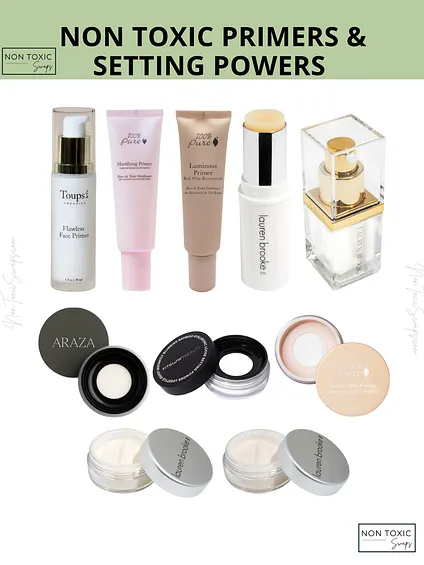
Best Non Toxic Primers + Setting Powders
FAQ
Talc can be contaminated with asbestos, a known carcinogen, and FDA testing has found asbestos in some talc-based cosmetics. A talc-free powder avoids the question.
No. Talc is its first ingredient, and it also contains four parabens and polymethyl methacrylate, a microplastic.
Cyclic silicones like cyclopentasiloxane (D5) are being restricted in the EU because they persist and build up in the environment. Other silicones aren’t on our list.
Final Thoughts
If you use primer and setting powder products on a frequent basis, you may be exposing yourself to unhealthy chemicals. Switch to safer options to eliminate daily exposure.
For the rest of your makeup bag, see our Non Toxic Eyeshadow and Non Toxic Lip Products guides.